
In India's social ecosystem, arranged marriage is not merely a means of finding a life partner but a symbol of union between two souls and their families. Its importance, rooted in culture and religion, has long been considered a sacred ceremony. However, this same institution has also functioned as a tool of oppression for women who were made to comply with family and social expectations — sacrificing their education, financial independence, personal autonomy and the right to choose their own life partner.
The idea that arranged marriage has changed has emerged from a confluence of factors: dating app fatigue, higher literacy rates and the growing financial independence of Indian women. As the institution's darker history gained wider acknowledgement, the term began to carry a more critical connotation, contributing to its gradual decline in its traditional form. The enactment of laws and the advocacy of women's rights contributed to this shift — but it was digitalisation that fundamentally altered the landscape of finding a life partner. Dating apps gave individuals the freedom to choose partners on their own terms, independent of family and society. But this freedom brought its own fatigue, born of ghosting, situationships and uncertainty. Fake profiles, hookup culture and mindless swiping discouraged those who came seeking genuine connection, compatibility and meaningful relationships.
Some found their partners through this route. Those who encountered disappointment have begun revisiting the arranged marriage structure — but with a significant change: the decision now rests with the individual rather than being imposed upon them. Yet the institution's foundational characteristics, which remain problematic in several respects, continue to invite doubt and scepticism.
What Arranged Marriage Was
According to Hindu custom, parents and relatives would choose a life partner for their children, guided by caste, financial status, social standing and physical appearance. Children — and especially women — were rarely given any autonomy in this process. Women were expected to relocate, give up their education, leave their jobs and surrender their freedom. There were many cases in which women were subjected to atrocities driven by excessive dowry demands, sometimes resulting in suicide. When the family's idea of marriage claimed authority over a woman's entire life while simultaneously cutting her off from support, some were pushed to a point of no return.
The Five Genuine Shifts
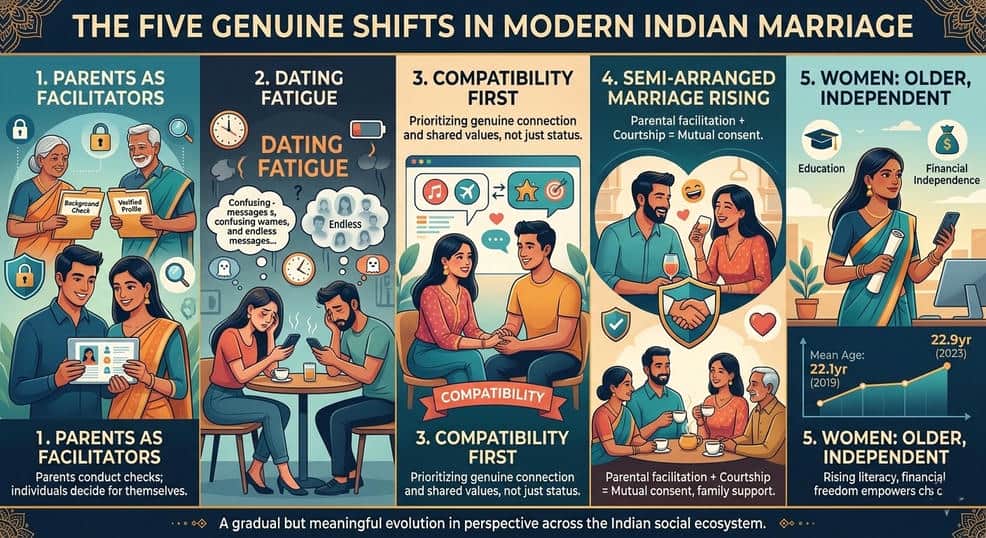
The shift that has allowed people to approach arranged marriage differently stems from a gradual but meaningful evolution in perspective across the Indian social ecosystem.
Parents as Facilitators: Unlike earlier times, parents are now largely confined to the role of facilitators rather than decision-makers. They find a suitable partner, conduct background checks and then allow the individuals to decide for themselves whether they are right for each other. This makes the process more transparent and secure for both parties.
Dating Fatigue: Finding a partner through dating apps has become an emotionally exhausting process. The endless swiping feels less like freedom and more like uncertainty, making it harder for people to form any meaningful connection over a sustained period.
Compatibility First: Selecting a partner is no longer determined solely by caste, financial status or parental preference, but increasingly by personal compatibility. People now take the time to meet and understand each other's outlook and preferences, and say yes only when they genuinely feel a connection.
Semi-Arranged Marriage Rising: The semi-arranged model combines the best of both worlds — parents find a potential partner after conducting the necessary background checks, offering transparency, security and family support, followed by a period of courtship in which the two individuals make the final decision themselves.
Women Older and Financially Independent: Rising literacy rates and financial independence have empowered Indian women to choose the timing of their marriage and their partner without being pressured or coerced by family or society. The mean age of marriage for Indian women has risen from 22.1 years in 2019 to 22.9 years in 2023 — a reflection of this shift.
Five Women, Five Experiences
The contemporary view of arranged marriage differs from person to person, shaped by individual experience. Some find it genuinely helpful; others still resist an arrangement that imposes others' decisions on them.
Nazreen Fazal—A 24-year-old London School of Economics alumna met a man through the arranged marriage process and decided to challenge convention. After their first meeting, they exchanged 80 emails in a week. Over two months of Skype calls and one face-to-face meeting, they decided to spend their lives together. She later wrote a viral Facebook post advising women to conduct their own due diligence before agreeing to a match — the post was shared 2,400 times. Her story is the clearest available example of what modern arranged marriage can look like in practice: the family introduced them; the couple decided everything after.
Amritha Mohan — In her personal essay published on Portsidereview, she writes: "My thesis supervisor is not exactly aware of this, but I enrolled in a PhD programme in Australia partly to get myself out of the Indian marriage market." She writes about arranged marriage with the clear-eyed perspective of someone who has watched it claim victims — including women whose deaths by suicide were linked to marriage-related issues. She notes that less than 6% of Indian marriages are inter-caste, that the institution is regularly legitimised by culture rather than critically examined, and asks the most important question in this conversation: "Arranged marriage implies some form of relative consent — but exactly how much force makes it forced?"
A voice from the TeamBlind community — An Indian woman on a professional forum writes: "Arranged marriage in modern India simply means introducing the guy and girl and letting them figure out in a feasible time frame if they want to get married. Online dating is exhausting. I don't see the point because I don't want to fool around and waste time." Another voice adds: "Gen Z opts for arranged marriage linked to a search for security and stability, disappointment over dating, and convenience in terms of family approval."
Upasana Chauhan — Writing in Time magazine, she describes her experience: "The girls around me were saying yes. When I met him, I was still meeting boys for an arranged marriage because I wanted to be the yes girl and follow the rule book. After a long two-year battle between my soul and my head, I finally said yes to marriage — knowing that this yes would mean saying no to my family and community." Her "yes" to her own choice cost her family relationships and required two years of internal struggle. Her article is titled "Why I Risked an Honour Killing to Reject an Arranged Marriage."
Pallavi (name changed) — As reported by CNN, this woman used an online matrimonial platform, filtering for compatibility rather than simply caste and family background, and conducted her own courtship before agreeing to marry. Her experience represents the most common one — not the woman who was coerced, not the one who rejected the system, but the woman who navigated it on her own terms and found it workable.
What Has Not Changed
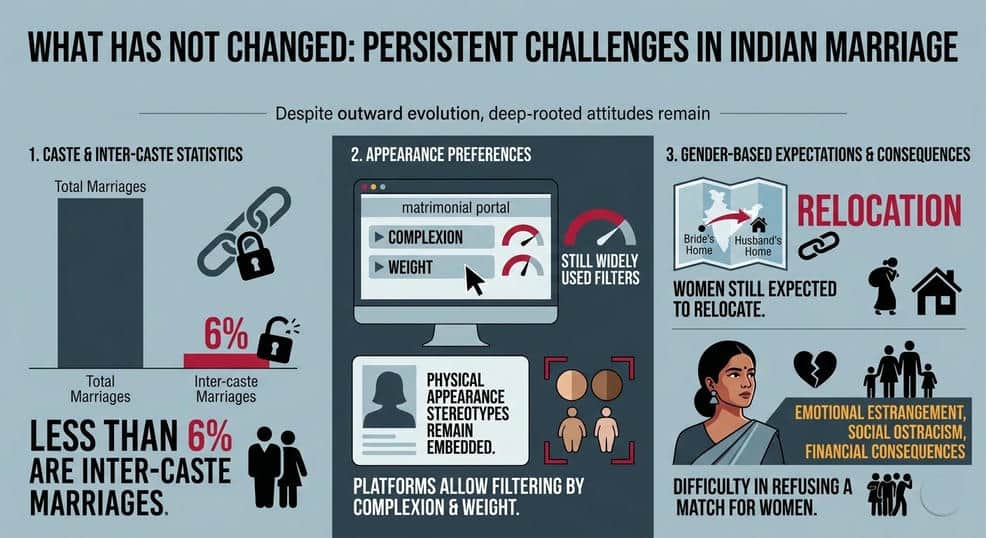
Though the process of arranged marriage has undergone significant evolution, certain deep-rooted attitudes and expectations continue to play a defining role.
Caste: Less than 6% of Indian marriages are inter-caste — a figure that underscores how persistently the caste system shapes matrimonial choices despite decades of reform and legal enforcement. The social permission to marry across caste has not grown commensurately with other forms of modernisation.
Complexion and Weight: According to CNN's reporting, matrimonial platforms still allow users to filter profiles by complexion and weight. This has not changed even in the context of progressive attitudes elsewhere — conventional standards of physical appearance remain embedded in the process.
Relocation: The expectation that women relocate to their husband's home remains a significant and contested factor in the arranged marriage process — one that many women cite as among the hardest expectations to push back against.
The Cost of Saying No: For a woman to refuse a match remains one of the most difficult decisions she can make. Such a refusal can result in emotional estrangement, social ostracism and financial consequences from her family and community.
Final Thought
In an era shaped by dating fatigue, fleeting relationships and the disillusionment of fake profiles, the quiet return to arranged marriage is not a compliance with convention or a rejection of modern values. It reflects something more nuanced — a genuine search for transparency, accountability and meaningful connection that the digital dating landscape has struggled to provide consistently. People are revisiting the arranged marriage structure, but on fundamentally different terms: the decision now belongs to the individual. The institution is changing — unevenly, imperfectly, but visibly. Whether it changes enough, and for whom, remains the question worth asking.