
The 21st century has rewired everything — from communication to business to warfare. The way these activities are performed is no longer confined to a limited space. On one hand, where the whole world connects digitally, it has also revealed the vulnerabilities that are now being exploited. For instance, the war between Iran, America and Israel, which pulled the global order into its orbit – when Iran threatened to attack major digital company facilities like Amazon, Microsoft, Tesla, and more, while blocking the Strait of Hormuz to disrupt the energy distribution. Its effects could be felt all over the world, from energy supply shortages to disruptions in digital networks, with connectivity coming along with its share of disadvantages.
The government is now concerned about its dependence on technology from another country, the misuse of social media platforms to spread misinformation and hatred, and using it as a tool for plotting against the state — forcing a reckoning with digital sovereignty, where the government keeps control over digital activities to prevent harm to both the people and businesses. However, it carries a cost that liberal democracies are reluctant to pay.
What is digital sovereignty?
Digital sovereignty is the ability of a state to control its own digital destiny — its infrastructure, its data, and the information that flows across its borders. Where the country keeps control over digital functions and prevents threats from taking root. This includes countering misinformation through social media, building state-based infrastructure to reduce dependence on foreign systems, preventing leaks of sensitive information to rival states, and strengthening its standing in the global technology order. At its core, it is a response to a simple but uncomfortable truth: a country that does not control its digital infrastructure does not fully control itself.
Why is it difficult to attain?
The idea of digital sovereignty comes with a possible threat to the freedom of expression and awareness that social media offers in today's world. Authoritarian countries like China that ban several foreign-based apps and sites, along with censoring users' profiles, showcase the danger of implementing this.
Aside from this, the critical resources required to build digital infrastructure — semiconductors, rare earth elements, and advanced technology — are concentrated in only a handful of states. Even European countries are heavily reliant on the US for their data security, as much of the software they use comes from American-based companies. India faces this same bind: pushing aggressively for data localisation laws and a sovereign technology stack while remaining deeply embedded in global digital networks built on American cloud infrastructure and Chinese hardware supply chains.
Furthermore, digital sovereignty imposed by the government might slow down development in this field, as legislative processes are too slow to keep pace with innovation.
Traditional war vs cyberwar
Our recent encounters with war are a reality check that contemporary warfare is not bound to borders, weapons, or the countries officially at war. The first attack by Russia on Ukraine was not physical but cyber — one hour before Russian tanks crossed the border, Moscow struck the American satellite company Viasat, cutting off communications across Ukraine and parts of Europe. The intention was clear: crumble the country's digital infrastructure before a single shot was fired. Likewise, the use of hackers to pinpoint the location of an important member of the Iranian government for assassination demonstrates the invisible hand in the current era of combat, pulling the strings without being physically present.
Analysing the situation while at war with Ukraine, Russia responded promptly. It banned Facebook, Instagram, and YouTube to some extent to stop anti-war and anti-government remarks, launching its own alternative apps and platforms. Though it is difficult to change public behaviour overnight, these platforms found space among users over time.
Ukraine, for its part, fought back with a tool no military doctrine had fully anticipated: its own people. The Ukrainian IT Army — a decentralised volunteer hacking force — launched coordinated attacks on Russian banks, state media, and logistics networks, at one point claiming responsibility for what was described as the largest DDoS attack in history. War had found a new recruit: a civilian with a laptop.
The private sector problem
What the Ukraine war exposed, more than anything, is a sovereignty paradox at the heart of modern conflict. Ukraine's military runs, in significant part, on infrastructure owned by private American companies – Amazon Web Services stores critical government data, Starlink provides battlefield communications, and Palantir's AI systems process military intelligence. Ukraine survives, in part, because these companies chose to help. But that choice belongs to the companies, not to Ukraine.
This is the uncomfortable truth that digital sovereignty forces every government to confront: if your national defence depends on a private foreign corporation, how sovereign are you really? The question is not hypothetical. When Elon Musk restricted Starlink access in certain regions of Ukraine in 2023, battlefield operations were directly affected. A sovereign military decision was, for a moment, subject to the preferences of a private individual. No treaty, no law, and no parliament had a say.
India's Place on Digital Sovereignty
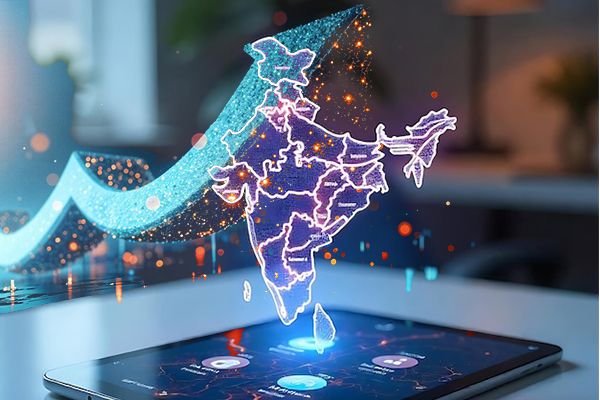
India faces a long road toward achieving complete digital sovereignty. While the government has taken imperative steps—such as banning foreign platforms like TikTok to prevent data abuse, developing indigenous military communication systems, and passing laws to intercept platforms threatening national security—severe structural vulnerabilities remain. A critical lack of domestic resources and an underdeveloped technological infrastructure force India to rely heavily on foreign technology. Ultimately, this dependence remains a major hurdle to safeguarding the nation's digital borders during times of crisis.
Final Thought
Digital sovereignty is not a binary choice between a sealed authoritarian internet and an open, vulnerable one. The real question — and the one no government has fully answered — is whether democracies can build genuine resilience without sacrificing the openness that defines them. Russia chose control and got an intranet. China built the Great Firewall. Neither model is one that a free society should want to import.
What the world needs is a third path: infrastructure sovereign enough to survive a war, open enough to remain worth defending. That balance has not yet been struck. But as conflicts increasingly begin not with a gunshot but with a line of code, the urgency of finding it grows with every passing crisis.