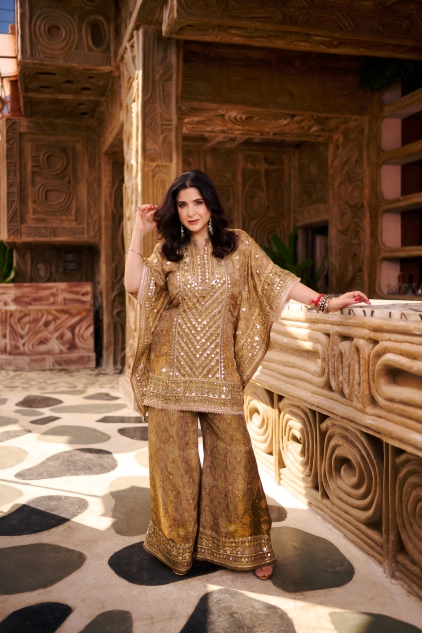
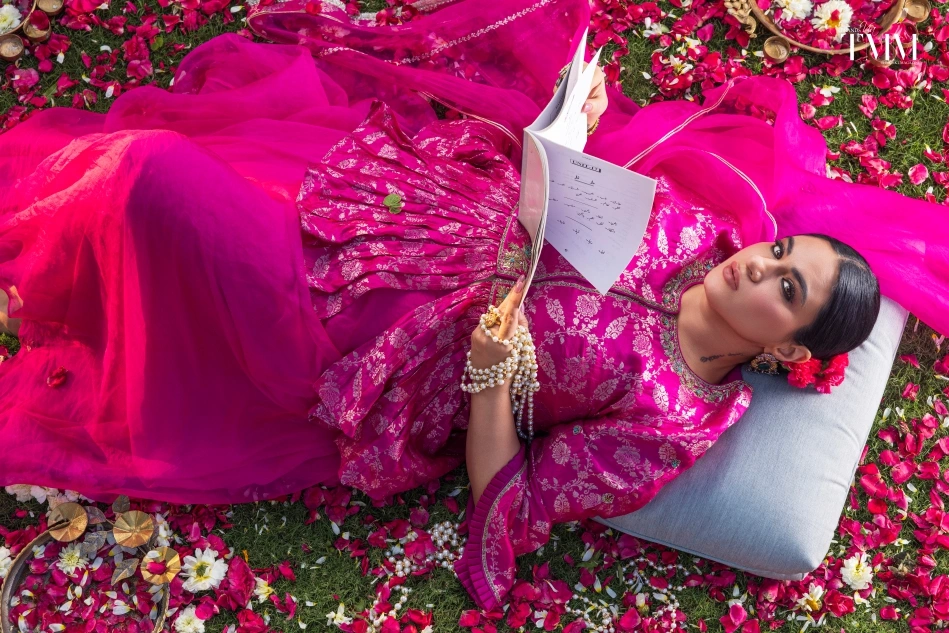
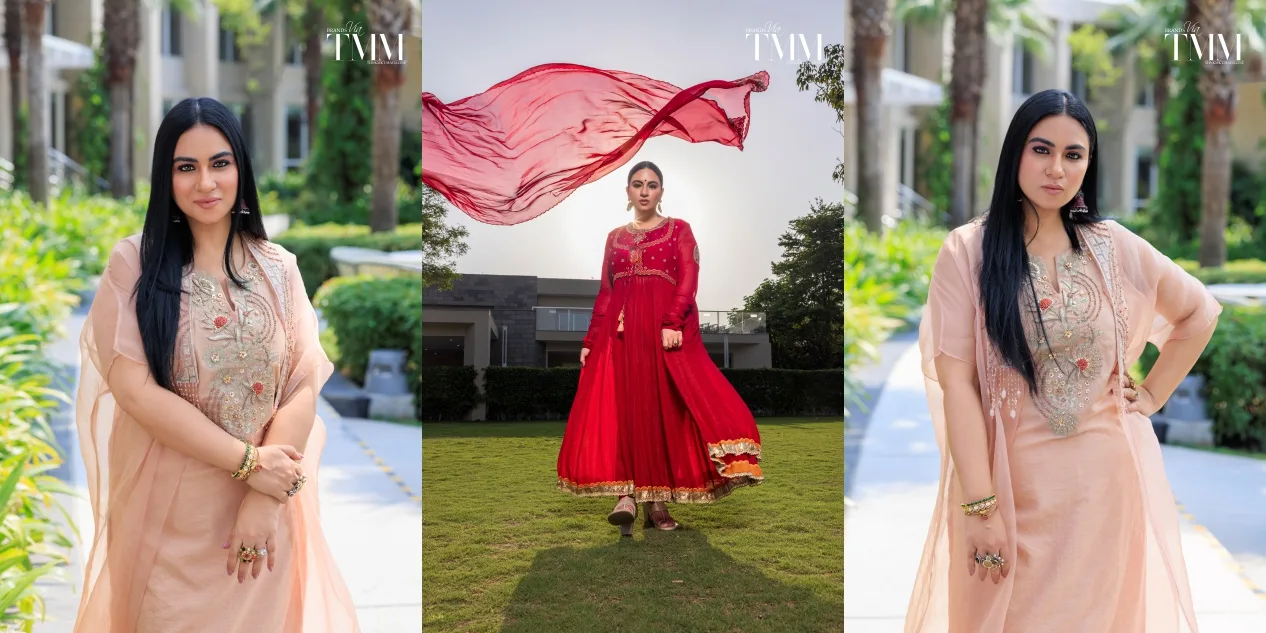
There are moments when a woman seems to carry an entire landscape within her. At Aravali Marriott Resort & Spa, against the lush, quietly dramatic backdrop of the Aravalis, Priya Malik arrives wrapped in red ethnic wear—a vivid silhouette against the muted greens and earthy tones of the resort. The colour feels almost symbolic: red for life, love, courage and the many incarnations of a woman. She is, after all, a poet who has spent years turning emotion into language, but motherhood has given her a new vocabulary—one made of lullabies, sleepless nights, fear, surrender and an unexpected sense of peace.
For Malik, motherhood did not arrive without uncertainty. Her journey to becoming Zoravar's mother began with loss, followed by a pregnancy she describes as a mixture of “fear and surprise". Yet somewhere between those two emotions emerged something she hadn't expected: an extraordinary calm.
Today, as she balances motherhood, marriage, travel and a demanding creative life, Malik speaks with the candour of someone who has discovered that becoming a mother doesn't necessarily mean becoming someone else. Sometimes, it means finally meeting the person you were always meant to be.
The Beginning: Fear, Surprise and a Little Miracle
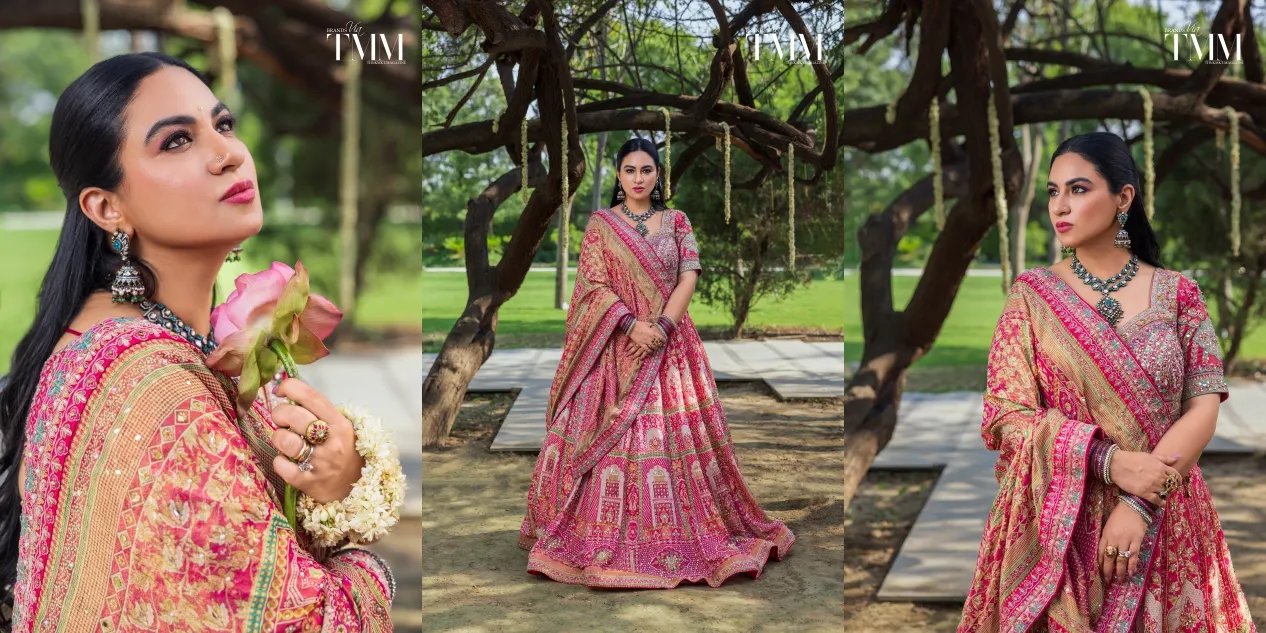
When Priya discovered she was pregnant with Zoravar, her first reaction wasn't uncomplicated joy. Just a month and a half earlier, she had experienced a miscarriage, and she had expected to give her body time to heal. Then came the unexpected positive pregnancy test.
“My first feeling was genuinely a mix of fear and surprise,” she recalls. Even her husband, Karan, found it difficult to believe. Her menstrual cycle hadn't returned, and the couple initially couldn't understand how another pregnancy could have happened so soon. A call to the doctor changed everything. On August 15—Independence Day—they rushed to the hospital, nervous and uncertain. The fear was simple and profound: would she be able to carry this baby? The doctor's reassurance that everything looked good brought relief. But the experience left Malik understandably cautious. She chose to keep the pregnancy private for months, even telling her mother only after six months.
And yet, what she remembers most vividly about those nine months is not fear. It is peace.
“Those Were the Calmest Nine Months of My Life”
“I am usually very anxious,” Malik says. “I'm always trying to get things done. Anything can trigger me at any time.” Pregnancy, strangely, brought the opposite. She describes those nine months as the calmest of her life—a period when she felt deeply connected to her body and to the child growing inside her. There was still the instinct to protect the pregnancy from public attention, but emotionally, she felt safe. “It was as if Karan and I were keeping this beautiful secret to ourselves."
That sense of connection became one of the defining emotions of her pregnancy. Instead of resisting the changes, Malik embraced them. She felt grateful for her body and, perhaps after the heartbreak she had experienced, deeply aware of what it was capable of giving her.
The Poet at 4 a.m.
For someone whose words are her second skin, motherhood did not silence the poet in Malik. If anything, it found her in the middle of the night. Zoravar was not a baby who slept easily through the night. One night, at around 4 a.m., Malik found herself holding him in one arm and typing with the other. A poem had arrived. She didn't know where it came from, and she didn't have time to question it. She simply began typing furiously, afraid that the thought would disappear. Interestingly, the poem wasn't about motherhood.
That detail says something profound about Malik's relationship with her art. Motherhood did not consume her creative identity; it became part of the ecosystem in which that identity could continue to breathe. “I always say that poetry is my first baby,” she says. “I gave birth to poetry.” For Malik, poems are born much like children are: a thought is conceived, nurtured, allowed to grow and eventually brought into the world.
Seeing Her Mother Through New Eyes
Motherhood also changed one of Malik's oldest relationships: the one she shares with her own mother. Growing up, she often felt that her mother understood her sister better. There was, she says, a communication gap—a feeling that her mother simply didn't “get” her. Becoming a mother changed that perspective. “It is such a beautiful and artistic thing to see your parents become parents again,” she says.
Watching her mother care for Zoravar allowed Malik to see her not merely as her mother but as a woman who had once navigated motherhood herself. The relationship became more wholesome, layered with gratitude and a new understanding. Her mother has also become one of her greatest pillars of support. With Malik's work requiring travel, performances and periods of solitude to write, having her mother around has made it possible for her to continue pursuing her career. Zoravar, affectionately, calls Priya “mama” and her grandmother “mummy”—giving him, in Malik's words, “two mamas.”
Motherhood as Meditation
Ask Malik what motherhood means to her, and the answer comes without hesitation: nurturing. She believes the instinct arrives almost immediately, from the moment a baby is placed in a mother's arms.
For years, Malik had described performing poetry as a meditative experience. She would close her eyes during certain passages and feel intensely connected to herself. Motherhood, she says, took that feeling somewhere deeper. “I don't think anything else can ever bring me so close to myself until I become a mum."
She also credits the timing of motherhood. Becoming a mother later in life, she believes, meant she had already confronted many of her insecurities and traumas and was emotionally, mentally, physically, financially and spiritually ready. “I have really embraced motherhood,” she says. “There is nothing about motherhood that I have resisted.”
The Courage to Speak About Loss
Perhaps the most vulnerable chapter of Malik's journey has been her decision to publicly speak about her miscarriage. She could have kept the experience private. Instead, she spoke about it on stage at Spoken Fest, in front of an audience. For Malik, sharing became a form of healing. She began researching miscarriage after her own experience and discovered how common it was. Then she began talking to women around her—and found that many carried stories they had never shared. Friends, cousins and relatives began telling her about their own experiences. “I thought, if this is happening in my close-knit circle, imagine the number of women who could benefit from the story and feel like they're not alone.”
Today, she continues to receive messages from women who have found hope in her story, particularly because her journey eventually led to Zoravar. For a poet, expression is part of the healing process. “Likhna is the first process for me. The second process is usko batana. And once that process is complete, I think that's when my healing begins.”
A Marriage Made Stronger
Motherhood has also deepened Malik's relationship with Karan. She believes that when a relationship is already strong, bringing a child into it can create another dimension of intimacy. She has watched her husband embrace fatherhood naturally, without needing reminders or instructions. “We are both nurturers by nature. We are both givers.”
Perhaps the most beautiful part, she says, has been watching someone she loves become a father—and watching him love their child with a tenderness that is equally powerful. “It’s just so beautiful to behold.”
Two Babies, One Woman
Did she ever consider stepping away from poetry to focus entirely on Zoravar? - Never. For Malik, motherhood and work are not competing identities. They nourish one another. “The fact that I get to do what I get to do makes me a better mother. And I think the fact that I'm a mother has also now made me a better poet.” Her philosophy challenges the familiar idea that a mother must sacrifice one part of herself to become fully present in another. Malik doesn't see her son and her poetry as two opposing worlds. They are both hers.
Raising a Child Without Choosing His Destiny
As a mother, Malik has aspirations for Zoravar—but not a predetermined career.
She wants him to give his best to whatever he chooses. If he loves football, she wants to give him professional coaching. If music becomes his passion, she wants to support that. Her role, she says, is to observe, identify his strengths and give him the best possible chance to develop them.
For Malik, there is a distinction between pushing a child and encouraging them to become the best version of themselves. “I don't believe in mediocrity,” she says.
The ambition is not that Zoravar should become something specific. It is that whatever he becomes, he should pursue it wholeheartedly.
The Woman Who Was Rearranged
Perhaps the most powerful transformation motherhood has brought Malik is invisible. “It is a very seismic shift that happens inside you,” she says. “You're fully rearranged from your insides.” Motherhood has given her poetry more depth and brought her closer to herself. She describes the expanding belly of a pregnant woman as a metaphor for what happens to her entire life: everything expands—the mind, the heart, the horizons. Some things are learned; others are unlearned. And perhaps that is the essence of Priya Malik's motherhood story. Not perfection. Not a manual. Not a carefully curated version of maternal life. But expansion. A woman who once feared whether she could carry a child now carries two great loves: her son and her poetry. One calls her “mama”; the other has called her to stages, pages and countless hearts.
Draped in red beneath the Aravalis, Priya Malik looks every bit like the poet she has always been. But there is something else in her presence now—a quietness, perhaps, born from knowing that life can break you, surprise you and still give you something extraordinary. Motherhood, for her, was not the end of the woman she was. It was her becoming.
Team Credits
Creative Director & Stylist: Pooja Gupta & Spectrum Styles
Photographer: Amit Hasija
HMU: Kanikka Gauraav Tandon
Outfit/Brands: Kosheen, Mirasa, Shreeka & House of Surya
Jewellery: Ministry of Good Souls
Location Partner: Aravali Marriott Resort & Spa, Delhi NCR